

Cédric Gouagout is no longer able to work. Since his time as a temporary worker at the Imerys mine in Glomel, in the Côtes-d’Armor, Gouagout has suffered from respiratory problems that have upended his family and professional life. Now, he has decided to speak out publicly, in a new investigation published on September 10, 2026 by the Breton investigative media outlet Splann!, about working conditions for Imerys employees and the consequences for their health. Climate Whistleblowers is supporting Gouagout in his legal efforts, including a legal action against Imerys, in an attempt to have the company found guilty of gross negligence (faute inexcusable de l’employeur).
In his bedroom, Cédric Gouagout keeps a nebuliser within reach. At 44, he speaks slowly, sometimes stopping to catch his breath. When he becomes tired, his body starts to shake. “I am forced to live with a damaged body,” says the former Imerys temporary worker.
A religious man, he compares himself to David facing Goliath, the multinational mining company. Although he has not worked since his assignment at the Guerphalès quarry in Glomel, in autumn 2021, he refuses to give up. He says he wants to fight for his family, but also for other workers at the site.
When he arrived at the site at the end of summer 2021, Cédric Gouagout thought he had found an opportunity. “I hoped that, by working with Imerys, I would earn more money to feed my family,” he says. He even dreamed of being hired permanently.
Operating since 1970, the Guerphalès quarry is described as the largest open-pit mine in France. Imerys Glomel, a subsidiary of the Imerys group, employs about 110 people in a town with nearly 1,440 inhabitants. The site extracts andalusite, a mineral prized for its resistance to very high temperatures and used notably in materials for the steel, foundry, cement and glass industries.
With about 65,000 to 67,000 tonnes of finished products each year, the Glomel site accounts for nearly a quarter of global andalusite production and supplies customers in about 30 countries, including France, Germany and China.
The dangers of crystalline silica
One of Gouagout’s temporary contracts at the Imerys Glomel site describes him as a “plant operator”. His duties include monitoring the facilities, cleaning, sampling materials, and various maintenance jobs. He is also required to operate construction machinery.
One line catches his attention: “Hazardous position: no”. No provision is made for enhanced medical surveillance.
Yet instructions given to employees by Imerys on October 18, 2021 explicitly mention the risk associated with “exposure to the risk of respirable crystalline silica”. They require FFP3 respiratory protection to be worn in certain areas and during certain operations.
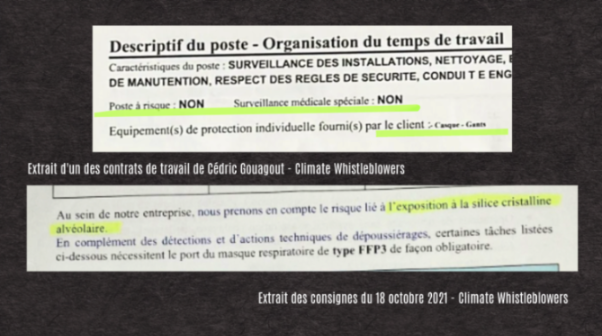
Excerpt from one of Cédric Gouagout’s employment contracts (above); excerpt from the instructions dated October 18, 2021 (below) – Climate Whistleblowers
The Guerphalès quarry is the only andalusite extraction site in Europe. The dust produced during the extraction and processing of the mineral can contain crystalline silica, exposure to which can cause serious respiratory diseases. According to France’s National Research and Safety Institute (INRS), crystalline silica is also classified as carcinogenic to humans.
“I could feel (the dust) getting in”
On his first day, Cédric Gouagout is introduced to the facilities and the safety rules. “I was welcomed and put in a room where there was a folder containing the safety rules. I had two hours to go through everything in the folder.”
He then tours the quarry in a pickup truck: the excavators, lorries, silos, and processing facilities. Very quickly, he says he was confronted with large quantities of dust.
“I didn’t feel protected because I had a beard. So I could feel (the dust) getting in. And in the evening, when I took a shower, I had dirt in my nose. In my mouth, I could feel that I had dust.”
At the time, he says he did not understand that exposure lasting only a few months could have lasting consequences. “Nobody told us there was any danger from the dust. And I didn’t think I would become disabled either,” he says. He adds: “The occupational health doctor had told me there was no risk (…) You can go ahead.”
As the weeks went by, he noticed a decline in his physical abilities, but was not yet concerned. He nevertheless filmed the facilities covered in dust, as well as a leaking pipe. He says he tried to show the footage to his supervisors, but he did not get the reaction he had hoped for.
“By the end of my assignment, I had been working for about three or four months, and that’s when I started to feel what felt like stabbing pains in my chest, which I still have today, burning sensations,” he says.
According to his account, the pain appeared during a machinery cleaning operation on November 22, 2021. That day, Cédric Gouagout says he was exposed to a greater quantity of dust than usual.
Four days later, on November 26 , the pain became severe enough for him to go to the emergency room at Carhaix hospital. A respiratory assessment was scheduled.
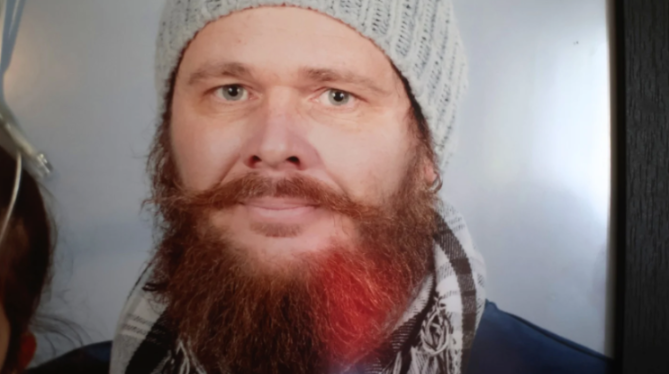
Cédric Gouagout didn’t realize that his beard could compromise the seal of his FFP3 mask.
A respiratory syndrome attributed to exposure
A scan performed on December 2, 2021 detected bilateral pulmonary emphysema and a micronodule. At the time, these abnormalities were not formally attributed to exposure to andalusite dust.
However, according to the medical records provided by Cédric Gouagout to Climate Whistleblowers, he suffers from Brooks syndrome, a form of occupational asthma that can occur following acute exposure to an irritant. The incident on November 22 , 2021 was recognised as a workplace incident.
In a certificate dated 2023, a doctor described Cédric Gouagout as suffering from “persistent asthenia following exposure to andalusite dust on 22/11/2021”.
His symptoms continued to worsen, without doctors being able to determine their precise origin or provide lasting relief.
In May 2024, his condition was described as aggravated exertional dyspnoea. But “the very slight pulmonary micronodular abnormality cannot for the time being be considered silicosis”, a medical report also stated. Silicosis is among the most serious diseases associated with exposure to crystalline silica.
“What I am experiencing is physical hell. I have difficulty speaking. I have difficulty walking. Today, I have difficulty doing everyday things in my home,” Cédric Gouagout says. He describes a fatigue that does not go away with sleep, which has become “not restorative”.
He has not worked since. He has launched legal proceedings against his former employer to have the company found guilty of gross negligence (faute inexcusable de l’employeur).
“I am fighting because I believe that if it happened to me, it will happen to others and I don’t want people to suffer like I do.”
Occupational exposure limits exceeded
Cédric Gouagout is the first Imerys Glomel whistleblower to speak publicly. But in recent months several former employees have described, in the Breton investigative media outlet Splann!, situations involving pollution and health and safety problems similar to those experienced by Cédric Gouagout, backing their accounts with documents and videos.
Reports by Imerys Glomel compiled following inspections by Apave, a French group specialising in risk management, were obtained by Climate Whistleblowers and the Breton investigative outlet Splann!.
The documents show that between March 2021 and April 2023, five of the nine locations examined had concentrations above the occupational exposure limit values (OELs). For the other four locations, the results were more favourable, but three had not been measured every year.
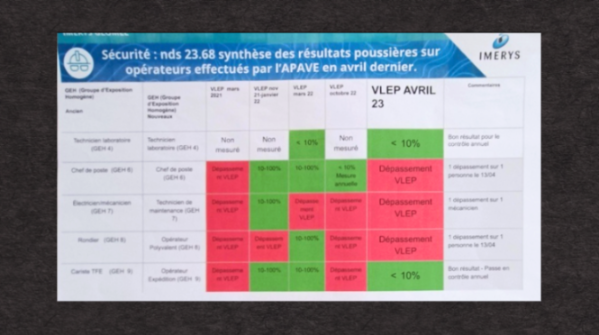
Internal Imerys documents show that occupational exposure limits have been exceeded.
The year 2021 appears particularly concerning in these records.
In a report dated October 2023, Apave also recommended several technical modifications intended to limit dust emissions, notably involving a silo and filtration systems. The document also stresses the importance of respiratory protection and the need to report leaks.
Obtained internal documents add to questions about working conditions at the quarry, while other alerts also concern the site’s environmental impact.
In March, Splann! revealed that in July 2021, Imerys Glomel had discharged between 3,000 and 3,500 litres of pure chemicals, which subsequently allegedly ran off towards settling basins that, according to the media outlet, were unable to fully treat them before they were discharged into the environment. The site has already faced several allegations concerning pollution.
Cédric Gouagout’s legal action is supported by Climate Whistleblowers.
Local elected officials have also begun to mobilise. Following Splann!’s revelations about the 2021 pollution, Jean-Yves Jégo, a municipal councillor in Glomel, decided to make a report under article 40 of the French code of criminal procedure, leading the Saint-Brieuc public prosecutor’s office to open a preliminary investigation in early April 2026.
Murielle Lepvraud, an MP from the leftwing LFI party representing Côtes-d’Armor, has challenged the government and called for an independent investigation into chemical risks to workers, local residents and the environment.
The move was welcomed by Cédric Gouagout. “It’s 2026, after all, we’re in France. It would be good if we didn’t get sick when we work.”
Contacted by Climate Whistleblowers, Imerys said that “the health and safety of our employees and temporary workers, as well as the protection of the environment, are priorities” and that “monitoring of the dust risk is carried out on a regular basis and, where necessary, is accompanied by an adaptation of preventive measures and personal protective equipment”. The group declined, however, to comment on an individual case.
Sonia Rolley, Head of investigations for Climate Whistleblowers
Read Splann!’s investigation of 10 September.